

Understand how and why your body composition changes during menopause and what you can do about it.
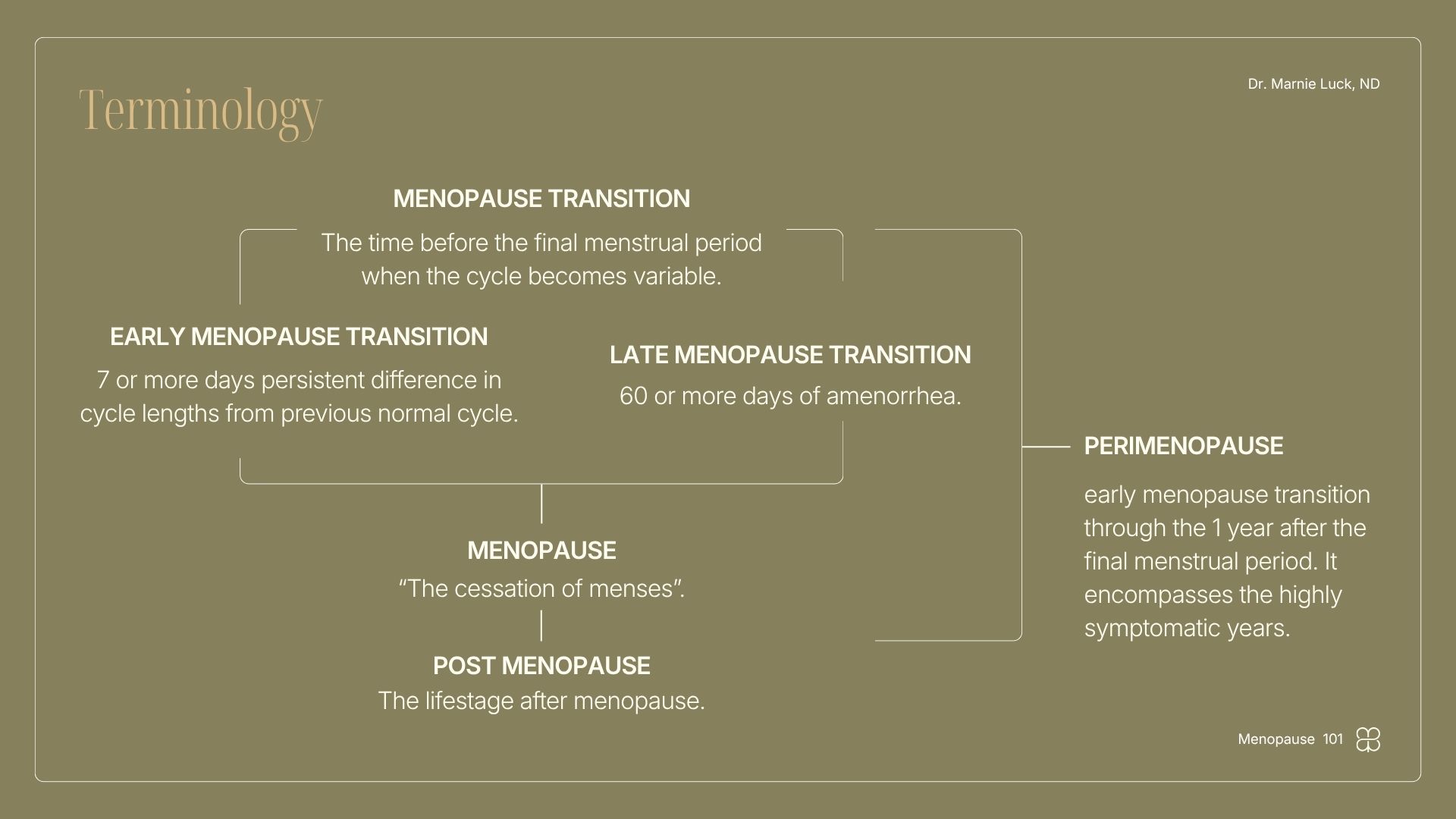
The menopause transition is the time before the menstrual period when the cycle becomes variable. A variable menstrual cycle is defined 7 or more days difference in cycle length from the previous cycle. For example, if you typically have a 28 day cycle, and then you have a 36 day cycle, that cycle would be considered variable. It that happens twice within a 10 month period, you would be considered to a persistent variable cycles and considered to be in the “early menopause transition” (congratulations, you have officially entered perimenopause!). When you start to have greater than 60 days between periods, you have now entered the “late menopausal transition”.
B
The variability of the length of the menstrual cycle creates different levels of circulating estrogen. The late menopausal transition specifically is accompanied by lower levels of estrogen and in post-menopause the body makes very little estrogen at low. The low estrogen state is partially responsible for various signs and symptoms of the menopause transition.
Muscles are organized in layers: whole muscle, bundles of fibres, individual muscle fibres, and tiny contractile units inside those fibres called sarcomeres. Within sarcomeres, actin and myosin filaments slide past each other to shorten the muscle and generate movement.
Muscles usually get bigger and stronger when they are challenged by resistance exercise, then repaired with enough protein, rest, and overall recovery. This growth is mostly an increase in the size of existing muscle fibres rather than making lots of brand-new fibres. If muscles are not challenged, they atrophy (get smaller and weaker).
Sarcopenia defined as low muscle mass and function (muscle strength and physical performance) can be conceived as an age-related condition, which begins around the fourth decade of life with an accelerated loss as age increases, especially in very old age (Cruz-Jentoft 2023).
Loss of muscle mass happens as we age (if we are not doing resistance training). Here is what the research says:
Primary sarcopenia is a multifactorial disease condition that entails perturbations to myostatin, inflammatory cytokines, and mitochondrial function as well as a loss of satellite cells, motor neurons, and anabolic hormones (Kakehi 2021,Yoo 2018). Primary sarcopenia is quite rare as most causes of sarcopenia are due to secondary causes. Common causes of secondary sarcopenia are:
The low estrogen state is partially responsible for various signs and symptoms of the menopause transition.
Metabolism is the sum of the chemical reactions that keep cells and the body alive. It includes two complementary processes: anabolism, which builds larger molecules and tissues from smaller parts, and catabolism, which breaks down molecules to release energy.
In simple terms, anabolism is the “building” side of metabolism, while catabolism is the “breaking down” side. The two work together: catabolism supplies energy and raw materials, and anabolism uses them to grow, repair, and store.
A quick example: after a meal, your body tends to favour anabolic processes to store nutrients and repair tissue; during fasting or exercise, catabolic processes become more active to provide fuel.
Metabolism balance usually means a state where the body’s energy use and energy production are in equilibrium, so nutrients are being used, stored, and released in a coordinated way. In general terms, it reflects homeostasis across metabolic processes rather than one single process.
In plain language, it means your body is neither consistently over-fueling nor under-fueling its systems; instead, processes like building tissue, breaking down fuel, and regulating blood sugar are kept in balance.
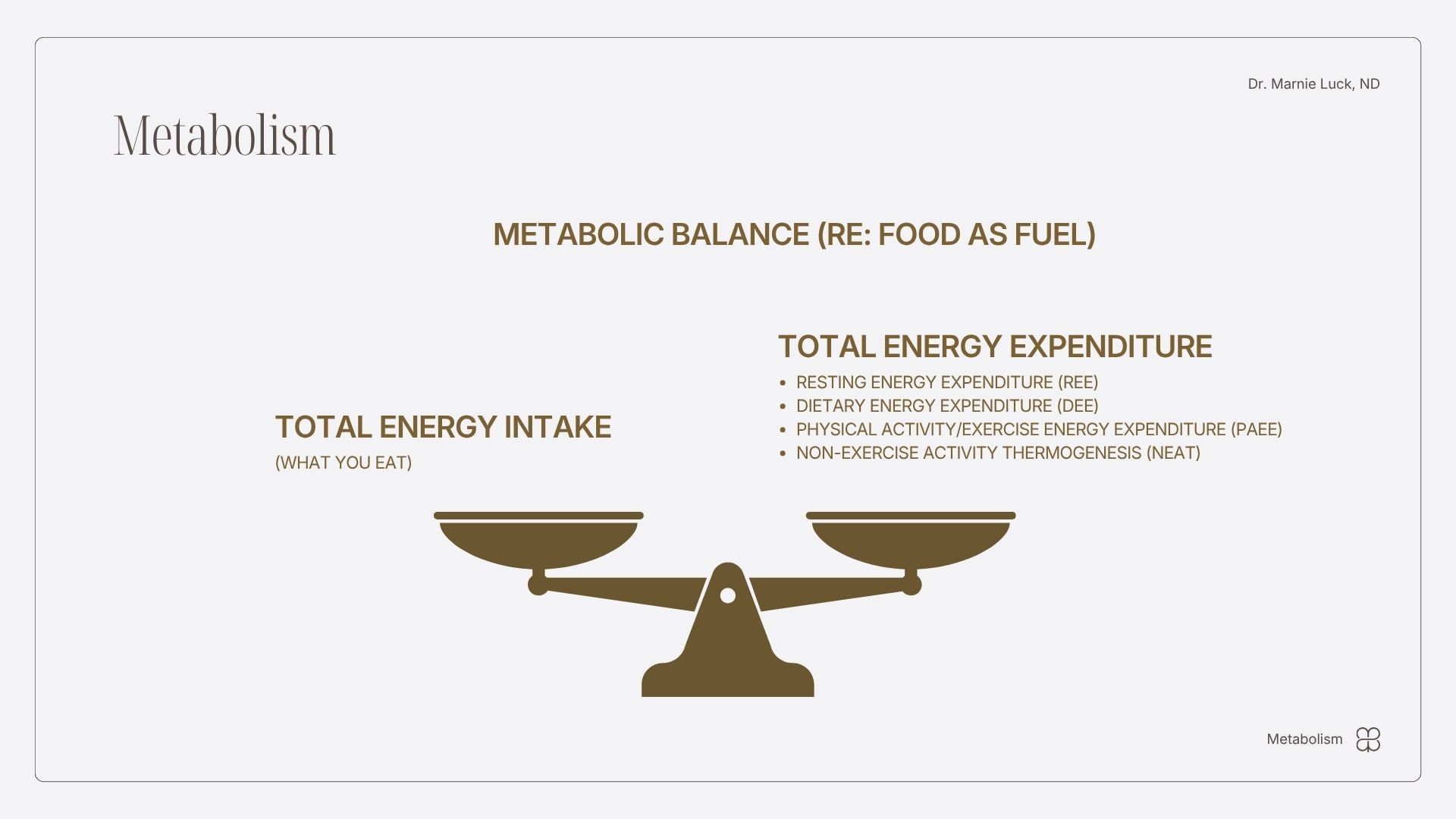
How much energy (calories) we consume must balance with our how much energy our body needs. Our total energy intake (what we eat) must be enough (but not more) for how much energy our body needs for its total energy expenditure.
Total Energy Expenditure includes:
Resting Energy Expenditure (REE): how much fuel our bodies burn when resting (not moving).
Dietary Energy Expenditure (DEE): how much fuel our bodies burn from eating food.
Physical Activity/Exercise Energy Expenditure (PAEE): how much fuel our bodies burn via exercise.
Non-Exercise Activity Thermogenesis (NEAT): the energy you burn from everything you do that is not sleeping, eating, or structured exercise. It includes daily movement like walking, standing, typing, doing chores, fidgeting, and other spontaneous physical activity.
“Aging and lifestyle seem to be the primary culprits behind weight gain in women around the time of menopause. Aging is associated with slowing of the metabolism. Lean body mass (muscle) decreases with age while body fat accumulates throughout adulthood. During the menopausal transition, women gain an average of 1 pound per year. However, average weight gain varies widely with 20% of women gaining 10 pounds or more during this transition period. This overall increase in body weight has not been proven to have a direct correlation to changes in hormonal status, but it appears to be related to increasing age and decreased energy expenditure. However, menopause is associated with increased abdominal subcutaneous and visceral adipose tissue deposition.” (Quoted from Knight 2021 in Menopause Journal)
More contemporary research has shed some light onto estrogens role (notable the loss of estrogen) in metabolism in menopause. Estrogen influences gynoid weight gain (putting weight on hips) whereas the absence influences android weight gain (putting weight on in the abdomen). Estrogen impacts brown adipose tissue in a variety of positive ways that influences Resting Energy Expenditure (REE). The withdrawal of estrogen (even in medically induced states with GNRH inhibitors) reduces REE and the addition of estrogen reverses this. (Weidlinger Aug 2023).
Additionally, a mechanism know as “The Protein Leverage Effect” as the main challenge for weight gain in menopause. It arises when progressive net bodily protein losses (from increased muscle breakdown of aging and low estrogen) induce increased appetite for protein. If there is not a corresponding increase in the dietary protein concentration, the predicted consequence is excess non‐protein energy intake (Simpson (2022). In plain language, increased appetite for protein is often met with just eating more in general (including more carbs and fat) resulting in weight gain.
Furthermore, "Anabolic Protein Resistance” which is universal across both sexes in aging means that more protein (per day and per meal) is required in order to preserve muscle mass in healthy adults. This means that while 0.83 g of protein per kilogram that the individual weighs per day (the current international recommendation) may preserve muscle in a younger adult (under 40, perhaps under 30 years of age) it would not be sufficient to preserve muscle in an older adult (>40 years of age). More contemporary research suggests that to preserve healthy muscle mass in healthy older adults equates to a protein intake of 1.2-1.6g/kg/day. For example, someone who is 75kg (165 pounds) would require 90 to 120 grams of protein daily to preserve muscle mass. (Nishimura et al., 2023).
Exercise and adequate protein intake are essential aspects of maintaining muscle and metabolic balance during the menopausal transition and beyond. Both the loss of estrogen and effects of aging play a role. Although the loss of estrogen can be somewhat modified by menopausal hormone therapy, aging is something we cannot change. For optimal muscle and metabolic health, the biggest drivers of positive change are diet and exercise.
1. Start to strengthen and build muscle (resistance training) well before menopause. Your own endogenous levels of estrogen have a positive impact on muscle health. A resistance training program is essential for maintaining (and building) muscle mass and strength in post-menopause,
2. Inactivity (lack of exercise and physical activity) are a risk factor for having low muscle mass. It’s easier for the body to lose muscle than it is to build it. Prolonged periods of inactivity are detrimental to muscle health.
3. Resistance training is essential to build strength, muscle mass and prevent sarcopenia. 1-3 45-60 minute sessions a week is suitable for most people.
4. A minimum of 150 minutes per week of exercise is essential to reduce risk of cardio-metabolic disease (diabetes, hypertension, heart disease, dementia, etc). The minimum 150 minutes should include both cardio and resistance training.
5. Physical activity (ie. your daily 10 000 steps) although it is very important, is not exercise and doesn’t count towards your 150 minutes.
What more can you do to support muscle and metabolism in menopause?
Consideration of Menopausal Hormone Therapy (if clinically indicated) could also be a part of your health decision making. Mitigating peri/menopausal symptoms like hot flashes, night sweats and sleep disturbances can often help people implement the diet and exercise changes necessary to support metabolic balance.